
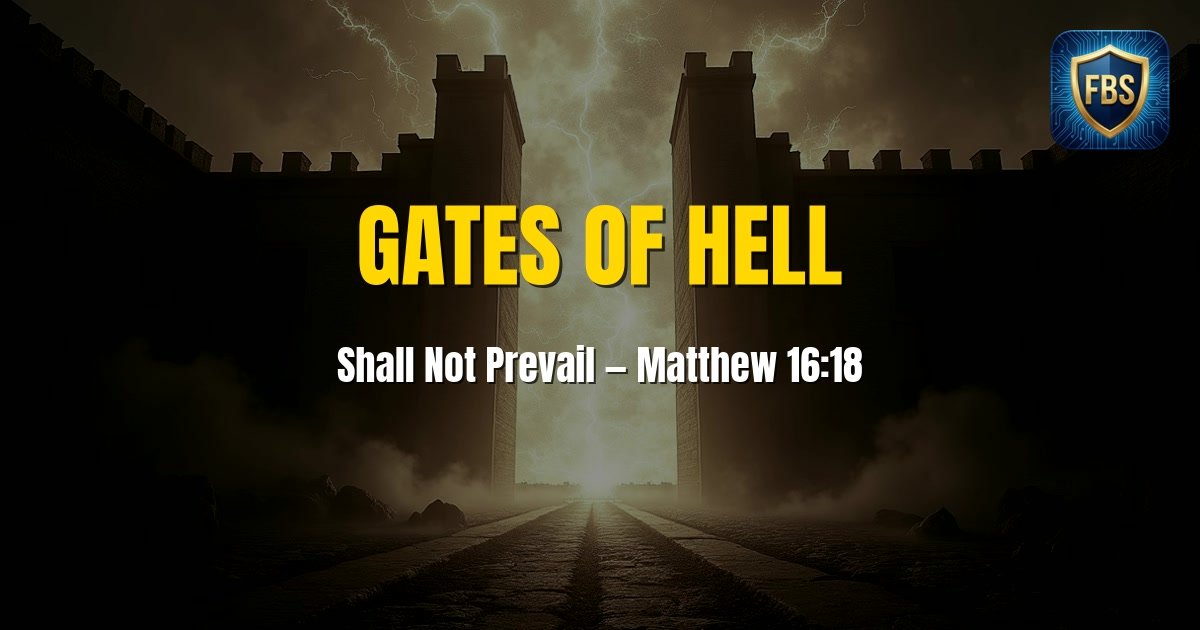

For generations, one sentence of Jesus has been read almost completely backwards. It is quoted for comfort while believers brace behind walls, waiting for the enemy to attack. But when you stand where Jesus stood and hear the words He actually chose, the verse stops sounding like a promise of survival and starts sounding like a declaration of war.
“And I say also unto thee, That thou art Peter, and upon this rock I will build my church; and the gates of hell shall not prevail against it.”
— Matthew 16:18
The Church was never meant to cower. She is the advancing army of Jesus Christ, and the gates of the enemy cannot hold against her. This study walks through the place Jesus chose, the confession that built the Church, the truth about those gates, the victory already won, and the armor He has placed in your hands.
The Shocking Place Jesus Chose
Jesus gave His most important teaching about the Church in the last place anyone would expect: a city called Caesarea Philippi, a notorious center of pagan worship in the far north of Israel. To a faithful Jew, it was spiritual poison — enemy territory in every sense.
Three massive temples stood there: one to Pan, the Greek goat-god; one to Zeus, the so-called king of the gods; and one to Caesar, whom Rome had declared divine. But the most terrifying sight was a deep cave the locals called the Gate of Hades — the gate of hell — which they believed was the actual doorway to the realm of the dead. Jesus did nothing by accident; He walked His disciples straight up to that cave on purpose, to declare that His Church would not hide from darkness but advance into it.
Peter’s Confession and the Rock
Surrounded by temples to dead gods, Jesus asked the most important question any person will ever answer: “Who do you say that I am?” Peter did not hesitate.
“Thou art the Christ, the Son of the living God.”
— Matthew 16:16
Jesus said flesh and blood had not revealed this — His Father in heaven had. No one reasons their way to who Jesus truly is; the Father reveals Him. And on that revelation, Jesus said, He would build His Church. Here the Greek matters. Jesus had nicknamed Simon Petros — a small stone, a pebble. But when He said “on this rock I will build my church,” He switched words to petra — a massive, immovable bedrock. The Church is not built on a man, but on the unshakable rock of who Jesus is: the Christ, the Son of the living God.
Gates Don’t Attack — They Defend
Here is where the verse has been misread for centuries. Preachers describe the gates of hell attacking the Church. But gates do not attack. Every gate you have ever seen stays in one place; gates are defensive structures, not weapons of war. So when Jesus said the gates of hell would not prevail against His Church, He was not picturing hell assaulting us — He was picturing us advancing on them.
The phrase is “the gates of Hades” — the gates of death, not of punishment; the prison where death holds people captive. And the word translated “prevail,” katischuo, means “to have strength against.” So the promise reads: the gates of death will not have the strength to resist the advance of the Church. Then Jesus immediately hands His Church the keys of the kingdom — and keys are for unlocking what gates try to keep shut. The mission was never survival. It is to break the gates and set the prisoners free.
The Stronger Man and the Finished Victory
Jesus told a short parable about a strong man guarding his palace, and a stronger man who overpowers him, strips off his armor, and plunders the house (Luke 11:21–22). Most believers cast themselves as the helpless victim and Satan as the strong man. But Jesus is the stronger Man. Satan is the strong man whose “palace” is the world system of sin and death — and the cross was not a tragedy but the battlefield where the stronger Man won.
“And having spoiled principalities and powers, he made a shew of them openly, triumphing over them in it.”
— Colossians 2:15
The word “spoiled” means to strip off completely. Jesus disarmed Satan, cancelled the record of sin that gave the enemy his legal claim, and nailed it to the cross. This changes everything: we do not fight for victory — we fight from a victory already won. The keys give us the authority to enforce what Christ has already accomplished.
Armed for the Assault
God never sends His people into spiritual war empty-handed. In Ephesians 6, Paul lists the full armor of God — the belt of truth, the breastplate of His righteousness, the shoes of the gospel, the shield of faith, and the helmet of salvation. Five pieces are mainly for protection. Only one is for attack.
“Put on the whole armour of God, that ye may be able to stand against the wiles of the devil… and take… the sword of the Spirit, which is the word of God.”
— Ephesians 6:11, 17
The sword of the Spirit is the rhema — a specific word of Scripture the Holy Spirit ignites for the battle in front of you. It is how Jesus answered every temptation in the wilderness: not by arguing with the devil, but by declaring, “It is written.” Add to this the weapon of Revelation 12:11 — believers overcome “by the blood of the Lamb, and by the word of their testimony.” And above all, put on Christ Himself; when the powers of darkness see you clothed in the One who already defeated them, they flee.
Three Things to Remember
1. We fight from Christ’s victory, not for it. The victory is already won, and it is already yours.
2. The Church advances, and the gates of hell cannot resist. You are not called to hide behind walls; you are called to take back what the enemy has stolen.
3. Put on the armor, speak the Word, and testify. That is how you apply the victory Christ has already secured. Stand in your authority, speak God’s truth, and serve His kingdom.
Watch the Series: The Gates of Hell Shall Not Prevail
This message is also available as a three-part video teaching on the Faith Bible Study YouTube channel.
Part 1: The Shocking Place Jesus Chose
Matthew 16:18 — Caesarea Philippi, the three pagan temples, the cave they called the Gate of Hades — and Peter’s revelation that became the bedrock of the Church.
Part 2: The Gates Cannot Stand
Colossians 2:15 — Why gates defend rather than attack, how the Church became the advancing army, and how the stronger Man stripped the enemy bare at the cross.
Part 3: Armed for the Assault
Ephesians 6:11-13 — The full armor of God, the sword of the Spirit, the word of your testimony, and what it means to put on Christ Himself and advance.
Subscribe to the Faith Bible Study YouTube channel and share this teaching with someone who needs to trade a hiding place for their marching orders.
Frequently Asked Questions
What did Jesus mean by “the gates of hell shall not prevail”?
Gates are defensive, not offensive. Jesus was not promising the Church would survive an attack; He was declaring that the Church would advance on the gates of death and they would not have the strength to resist.
Where is Caesarea Philippi, and why did Jesus teach there?
It was a pagan worship center in northern Israel with temples to Pan, Zeus, and Caesar, and a cave the locals called the Gate of Hades. Jesus deliberately chose this enemy territory to declare that His Church would confront darkness, not flee from it.
What is the difference between petros and petra?
Petros means a small stone or pebble (Peter’s name). Petra means a massive bedrock. Jesus built His Church not on Peter the pebble, but on the petra — the revelation that Jesus is the Christ, the Son of the living God.
What does it mean to fight from victory rather than for it?
At the cross, Jesus disarmed Satan and cancelled the record of sin (Colossians 2:15). The battle is already won, so believers enforce Christ’s finished victory rather than struggle to achieve it.
Content License: This article is published under the Creative Commons Attribution-NonCommercial-NoDerivatives 4.0 International (CC BY-NC-ND 4.0) license. You may share this article with attribution and a link back to the original URL. Commercial use, paraphrasing without attribution, or republishing without written permission is prohibited. © 2026 Faith Bible Study — Joseph S. Olarewaju.